
An estimated $124 trillion will transfer through 2048, including nearly $40 trillion in spousal transfers to widowed women. At the same time, women’s health receives just 6% of private healthcare investment. These are not automatically one investment thesis but together they create an important capital-allocation question.
For private wealth professionals and the HNW clients they advise, that thesis demands a direct answer to a direct question: is women’s health actually a good investment opportunity? Not whether it is compelling as a narrative. Not whether it aligns with values. Whether it passes the same disciplined capital allocation test applied to any other category.
I spent more than two decades working across private banking, wealth and asset management, advising sophisticated investors on portfolio construction, investment risk and capital allocation. I am going to answer that question from that seat.
The demand was always there. The infrastructure was not.
Over the course of my career, I had a version of the same conversation many times. A client — typically post-liquidity event or recently widowed, significant capital, sophisticated investor — would express a clear desire to allocate a portion of her wealth with precision and intention. Not philanthropy. She had already done philanthropy. She wanted an investment that reflected what she understood about the world from her own experience. Women’s health came up not because she had been told to care about it, but because she had lived it. When I went looking for a credible institutional-grade vehicle to meet that demand, it did not exist.
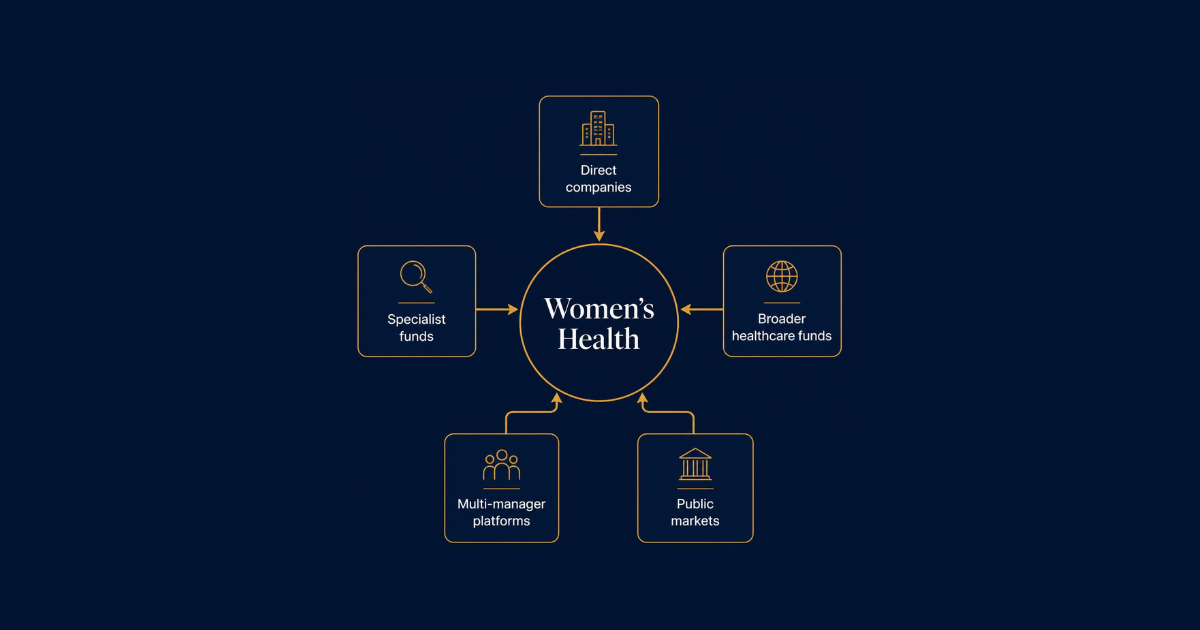
Early-stage venture funds were the closest thing available — but early-stage venture does not make it onto many approved product lists in private banking. The governance requirements, the liquidity profile, the risk framework all preclude it. Global health funds exist on approved product lists, but they are broad mandates. Women’s health is a rounding error within them, not a pure-play exposure. The client who wants to allocate with precision has nowhere to go.
The gap was not in appetite. It was in product. That observation matters for the investment case, because it means the undercapitalisation of women’s health is not a signal of weak demand. It is a structural artefact of how private wealth allocates and structural artefacts, when they are corrected, release capital quickly.
The convergence that changes the calculation
Two forces are now meeting at the same moment, and understanding their intersection is the core of the investment thesis. The first is the scale of the funding gap.
Despite women and girls making up nearly half the world’s population, women’s health has captured just 6% of private healthcare investment. (World Economic Forum). The concentration is narrower still: available funds have mainly flowed into women’s cancers, reproductive health, and maternal health, while other high-burden, high-prevalence conditions affecting women uniquely, differently, or disproportionately remain underfunded (Morningstar). Conditions such as endometriosis, polycystic ovary syndrome, and menstrual health affect tens of millions of women worldwide, yet account for less than 2% of women’s health investment.
The second is the Great Wealth Transfer. Women are projected to inherit approximately 70% of the $124 trillion great wealth transfer over the next 25 years. (CNBC)
By 2030, women will control $34 trillion in investable assets — three times the quantity they possessed at the start of this decade. (Citizens Bank)
These are not two parallel stories. They are one structural shift. The people receiving the largest capital transfer in history are the same people who represent the largest underserved patient population in the global healthcare system. When capital and conviction align at that scale, the direction of flow is not speculative. It is foreseeable.
In institutional practice, positioning ahead of a foreseeable, catalyst-driven capital flow is not a bet. It is a thesis with an identifiable trigger. The trigger here is demographic, measurable, and already underway.
The quantified opportunity
The investment case does not require an assumption of future demand creation. The demand already exists. The gap is one of supply — and the size of that supply gap has now been quantified by the institutions best placed to measure it.
The McKinsey Health Institute, in collaboration with the World Economic Forum, found that addressing the 25% more time women spend in poor health relative to men could boost the global economy by at least $1 trillion annually by 2040. (McKinsey & Company).
At the condition level, the numbers are equally concrete. A recent analysis by BCG estimates that effectively addressing four therapeutic areas — cardiovascular disease, osteoporosis, menopause, and Alzheimer’s disease — for women in the US alone could unlock a market opportunity exceeding $100 billion by 2030. World Economic Forum These are not rare or emerging conditions. They are high-prevalence, well-understood diseases where women are affected at disproportionate rates and where the standard of care, if properly delivered, already exists.
According to World Economic Forum research, every $1 invested in women’s health generates approximately $3 in economic growth. World Economic Forum. This is a macroeconomic-impact estimate, not a forecast of investment returns. It strengthens the case that better women’s-health outcomes can create substantial economic value, but individual investments must still be assessed on clinical evidence, commercial adoption, reimbursement, management quality, valuation and exit potential.
The portfolio construction argument
Beyond the standalone return case, women’s health has a characteristic that every disciplined allocator should recognise: it is genuinely diversifying.
A typical UHNW private markets portfolio carries significant private equity exposure which means cyclical beta, rate sensitivity on the financing side, and exit dependency on M&A and public markets conditions. Real assets provide some inflation protection. Hedge fund exposure varies. What most of these portfolios lack is meaningful exposure to demand that is non-discretionary and demographically driven rather than economically driven. Women’s health sits in that space.
The patient does not defer a menopause diagnosis because credit spreads widen. Alzheimer’s prevalence does not fall in a recession. Cardiovascular disease does not respond to rate cycles. The demand profile is structural driven by biology and demographics, not by consumer sentiment or economic expansion.
In factor terms, that is a low-correlation exposure relative to the cyclical risk most private wealth portfolios already carry. And in portfolio construction, low-correlation exposures have value independent of absolute return; they reduce volatility at the portfolio level and provide resilience across economic regimes. Women’s health may provide differentiated exposure to healthcare demand driven by biology, demographics and unmet clinical need. But the underlying investments still carry venture and private-market risks, including illiquidity, financing dependency and uncertain exits.
Within a private markets allocation, and at the appropriate sizing which takes the clients overall liquidity profile and risk tolerance into account, the diversification benefit is can be material without concentrating the portfolio in a single thematic.
The conclusion
The question this article set out to answer was whether women’s health passes a rigorous capital allocation test. Women’s health passes the first test of a credible investment opportunity: substantial unmet need, identifiable markets, growing commercial activity and persistent capital gaps. But that does not make every women’s-health company or fund investable. Returns will depend on clinical and commercial evidence, management quality, valuation discipline, access, portfolio construction and the choice of investment vehicle. The opportunity is real; capturing it requires specialist judgement and appropriate investment infrastructure.