
A woman diagnosed with breast cancer faces a consequential question: will chemotherapy improve her outcome enough to justify its burden?
The answer depends on more than the diagnosis. The biology of her tumour, the extent of her disease and her menopausal status can all matter. Understanding those differences can change the treatment decision.
For investors, the opportunity is to identify where that understanding can become a useful solution, earn a place in care and support a lasting business.
What is The Precision Premium?
The Precision Premium is the potential value created when a more precise understanding of biology, clinical needs and lived experience leads to better healthcare and durable businesses.
I coined the term to describe this connection between better understanding and investable value.
The thesis applies across diagnostics, therapeutics, devices, care models and healthcare technology, with women’s health as a leading edge. Women’s health makes visible the importance of differences between people, biological changes over time and needs that existing care has poorly served.
What precision reveals
Population averages are essential to medicine. But an average can conceal a difference that matters to a treatment decision.
Consider zolpidem, a medicine used for insomnia. In 2013, the US Food and Drug Administration required lower recommended doses for women because they eliminate the drug more slowly. Eight hours after a 10 mg dose, approximately 15% of women and 3% of men in pharmacokinetic studies had blood concentrations above a level associated with potential driving impairment. Understanding the difference changed the recommended dose.[1]
Precision also means recognising that the same person’s biology changes over time.
A pregnancy complicated by gestational diabetes can reveal metabolic vulnerability that persists long after delivery. A 2020 systematic review found that women with previous gestational diabetes had approximately 9.5 times the relative risk of developing type 2 diabetes compared with women without that history.[2]
That history can inform prevention. In a Diabetes Prevention Program analysis of women with impaired glucose tolerance and previous gestational diabetes, intensive lifestyle intervention and metformin each reduced diabetes incidence by approximately 50% compared with placebo.[3]
The menopause transition provides another example. Longitudinal SWAN research found that total cholesterol, LDL cholesterol and apolipoprotein B rose particularly around the final menstrual period, while several other cardiovascular risk markers followed patterns more consistent with ageing.[4] The timing of a biological change can therefore contain information that age alone does not fully capture.
A third dimension is the experience of living with a condition and navigating care.
A multinational endometriosis study published in 2011 reported an average interval of 6.7 years between symptom onset and surgical diagnosis. Affected participants also reported losing an average of 10.8 hours of work productivity each week, principally through reduced effectiveness while working.[5]
Understanding that burden helps define what a better solution must accomplish. Its usefulness may depend on recognising symptoms earlier, reducing treatment burden or making care easier to access.
These dimensions give precision a practical meaning: understanding a meaningful difference well enough to act on it. That understanding can inform diagnostics, therapeutics, devices, care models and healthcare technology.
The Precision Premium Framework
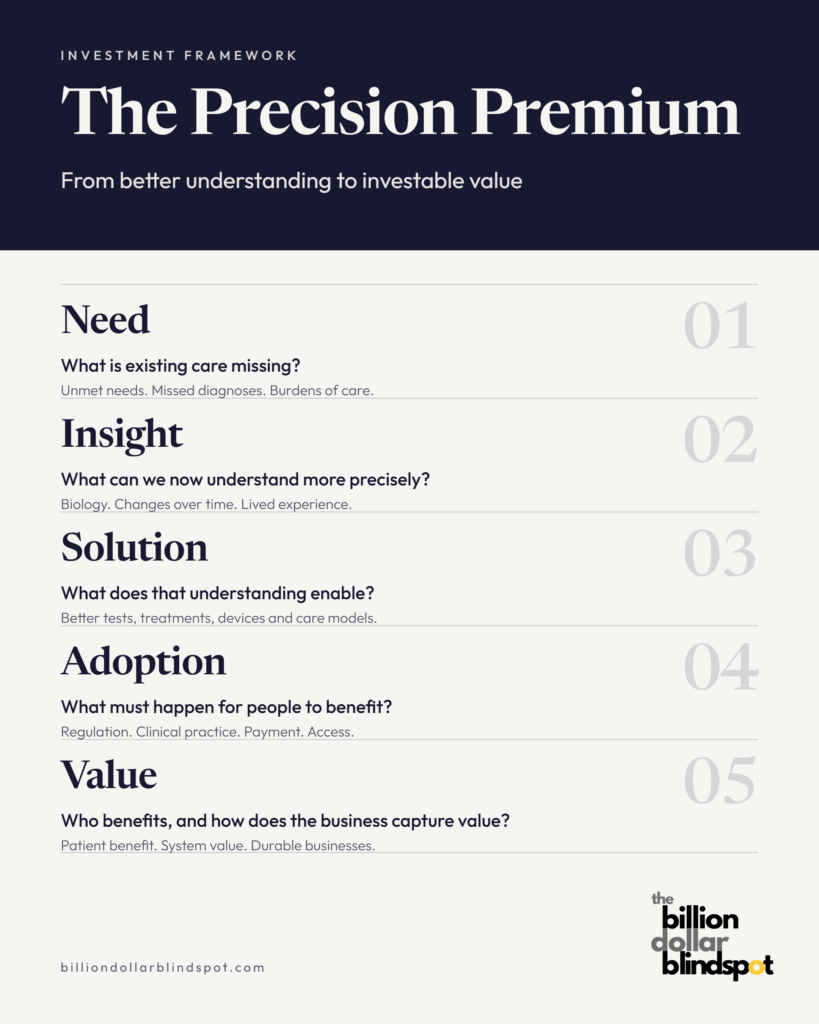
The Precision Premium framework examines how that understanding can become better care and a durable business. It follows five stages: Need → Insight → Solution → Adoption → Value.
1. Need: What is existing care missing?
Identify the people whose needs are poorly served and the consequences: a missed diagnosis, an ineffective treatment, an avoidable complication or a burden that remains unaddressed.
2. Insight: What can we now understand more precisely?
Identify the biological difference, change over time or experience of care that makes a better approach possible. Assess whether the evidence is strong enough to inform a clinical or care decision.
3. Solution: What does that understanding enable?
Establish how the insight translates into a better test, treatment, device or care model—and what improvement it delivers compared with existing care.
4. Adoption: What must happen for people to benefit?
Examine the route into use: regulation, clinical practice, reimbursement and patient access. Identify who acts on the information, who pays and what must change for the solution to reach patients.
5. Value: Who benefits, and how does the business capture value?
Determine what improves for patients and healthcare systems, then examine how the company earns revenue from delivering that improvement. Assess whether its margins, competitive position and capital requirements can support a durable business—and whether the investment price reflects the risks.
The stages are connected. A substantial need does not establish that a proposed solution works. Clinical usefulness does not settle how it will be adopted or paid for. Each connection forms part of the investment case.
Stage Investment question Need What is existing care missing? Insight What can we now understand more precisely? Solution What does that understanding enable? Adoption What must happen for people to benefit? Value Who benefits, and how does the business capture value?
How understanding becomes value
Genomic testing in breast cancer illustrates the pathway.
Two women with the same broad breast-cancer diagnosis may not benefit from the same treatment. Genomic testing examines the activity of genes in a tumour, providing information that can help clinicians decide whether chemotherapy is likely to add benefit.
The RxPONDER trial shows why that information must be interpreted in the context of the patient. It studied women with hormone-receptor-positive, HER2-negative breast cancer that had spread to one to three lymph nodes, whose genomic recurrence scores were 25 or below.
Among postmenopausal women in the trial, adding chemotherapy to endocrine therapy did not improve invasive disease-free survival. Among premenopausal women, it did: five-year invasive disease-free survival was 93.9% with chemotherapy plus endocrine therapy, compared with 89.0% with endocrine therapy alone.[6]
The useful insight was the combination of tumour biology and menopausal status. Together, they helped identify women who could avoid chemotherapy and those who could benefit from it.
The need was a more informed treatment decision. The insight concerned differences in tumour biology and treatment response. The solution supplied information relevant to that decision, with defined uses of genomic testing entering clinical guidance.[7]
This creates a clear purpose for a test within care. When it is adopted and paid for, supplying that information can support a business. Exact Sciences, which supplies Oncotype DX, reported $717 million in precision-oncology revenue in 2025 across Oncotype DX and other therapy-selection tests.[8] That revenue illustrates an established commercial business around more informed treatment decisions.
Pre-eclampsia testing shows how the pathway can also create value for a healthcare system.
In the UK PARROT trial, placental growth factor testing combined with a management algorithm reduced median time to diagnosis from 4.1 days to 1.9 days among women with suspected preterm pre-eclampsia.[9] A trial-based economic analysis estimated a saving of £149 per patient tested, including the test cost [10], and NICE recommends specified PlGF-based tests alongside standard clinical assessment for suspected preterm pre-eclampsia.[11]
Here, a biological signal helped clinicians assess patients sooner. Its use within a clinical pathway also changed resource use, creating estimated system savings. The business assessment would then examine payment, testing volumes, delivery costs and competition.
Better understanding can also lead to new treatments.
Fezolinetant targets a receptor involved in the regulation of body temperature, providing a nonhormonal approach to menopausal hot flushes. In the SKYLIGHT 1 trial, the 45 mg dose reduced daily moderate-to-severe hot-flush frequency by 2.55 more episodes than placebo at week 12.[12]
This extends the opportunity beyond diagnostics: understanding a biological mechanism can support a treatment for an important clinical need. Its commercial potential depends on whether the benefit, safety profile, access and payment arrangements support sustained use.
Across these examples, value takes different forms: a more informed treatment choice, a faster diagnosis, more effective use of healthcare resources or relief from symptoms. The investment question is how a business can deliver and capture that value sustainably.
Precision must change care
The connection between understanding and action is critical.
A trial across 10 Scottish hospitals illustrates why. Introducing a more sensitive blood test with different thresholds for women and men identified more women with heart-muscle injury. However, it did not improve the measured one-year outcomes, and women remained less likely than men to receive coronary treatments.[13]
In this example, better recognition opened a possibility, but realising its value required effective action within the care pathway.
For investors, this makes adoption central to the assessment. What happens after data is generated or a result is provided? Who changes the treatment decision? What allows an effective solution to reach patients consistently?
The Precision Premium lies in completing those connections: from an overlooked need to a meaningful insight, from that insight to a useful solution, and from clinical adoption to sustainable commercial value.
Women’s health brings many of these opportunities into focus. The framework gives investors a way to assess which opportunities have a credible path from better understanding to better care and a durable business.
Notes and references
[1] FDA zolpidem dosing action, 2013. Blood concentrations were a measure of potential next-morning impairment; the cited studies did not themselves establish a reduction in driving accidents.
FDA communication[2] Vounzoulaki et al., BMJ, 2020. Systematic review and meta-analysis of observational cohorts. Pooled relative risk was 9.51, with a 95% confidence interval of 7.14–12.67. Follow-up, populations and diagnostic criteria varied. The association does not establish causation or an individual’s absolute risk.
Original review[3] Ratner et al., JCEM, 2008. The analysis concerned 350 women with previous gestational diabetes and impaired glucose tolerance within the Diabetes Prevention Program. It does not establish the effectiveness of a routine postpartum identification programme.
Original study[4] Matthews et al., JACC, 2009. SWAN examined longitudinal changes around the final menstrual period. The findings concern cardiovascular risk markers rather than demonstrated cardiovascular events attributable to the transition.
Original study[5] Nnoaham et al., Fertility and Sterility, 2011. The study included women attending for laparoscopy across 16 centres in 10 countries. Productivity measures were self-reported. These figures describe that study population and period, rather than all patients’ experiences today.
Original study[6] Kalinsky et al., NEJM, 2021 — RxPONDER. Findings apply to the specified breast-cancer population. Invasive disease-free survival is not the same as overall survival. The study did not resolve how much of the premenopausal benefit arose from chemotherapy’s direct effects versus ovarian suppression.
Original study[7] NICE tumour-profiling guidance. Recommendations apply to specified populations and tests, with conditions attached to some uses.
NICE recommendations[8] Exact Sciences, full-year 2025 results. Precision-oncology revenue includes Oncotype DX and other therapy-selection tests. It does not establish revenue or profitability attributable solely to the breast test, or investor returns.
Company disclosure[9] Duhig et al., Lancet, 2019 — PARROT. A stepped-wedge, cluster-randomised trial across 11 UK maternity units. The intervention combined testing with a management algorithm. The study also reported fewer severe maternal adverse outcomes after adjustment, a secondary finding with relatively few events, but did not demonstrate a perinatal benefit.
Original study[10] Duhig et al., BJOG, 2019. The £149 saving was estimated using trial resource data and economic modelling from an NHS perspective. It is not an audited national cash saving or evidence of supplier profitability.
Economic evaluation[11] NICE PlGF guidance. Recommendations cover specified tests alongside standard clinical assessment for suspected preterm pre-eclampsia between 20 weeks and 36 weeks plus 6 days of pregnancy.
NICE recommendations[12] Lederman et al., Lancet, 2023 — SKYLIGHT 1. The figure is the difference in change from baseline versus placebo at week 12. Fezolinetant illustrates mechanism-based treatment development rather than individually tailored prescribing. In December 2024, the FDA added a boxed warning for rare but serious liver injury, with monitoring requirements relevant to adoption and delivery.
Original study · FDA safety communication[13] Lee et al., JACC, 2019 — High-STEACS. The trial included 48,282 patients. Introducing a high-sensitivity troponin assay with sex-specific thresholds increased identification of myocardial injury by 42% in women and 6% in men. Implementation changed both the assay and thresholds, so increased identification cannot be attributed solely to sex-specific thresholds. The assessed outcome was recurrent myocardial infarction or cardiovascular death at one year.
Original study
Related Posts
Women’s Health Investment Opportunity: What Investors Should Know