
Women’s health is attracting more investor attention than it has in years but one question remains on the minds of institutional allocators.
For family offices and institutional allocators asking how to invest in women’s health, the first challenge is access. Women’s health spans multiple healthcare subsectors, investment stages and risk profiles, but the routes available to investors remain fragmented.
Most allocators I talk to already accept that women’s health is becoming an attractive theme. The more important question is how to obtain credible, appropriately diversified exposure inside a normal institutional framework.
That distinction is important because women’s health is a healthcare investment domain spanning multiple conditions, technologies, business models, stages and geographies, and investors cannot access it through a single security, benchmark or standardised product. Investing well requires more than identifying an important theme; it requires selecting the right vehicles, managers and portfolio structure.
In brief
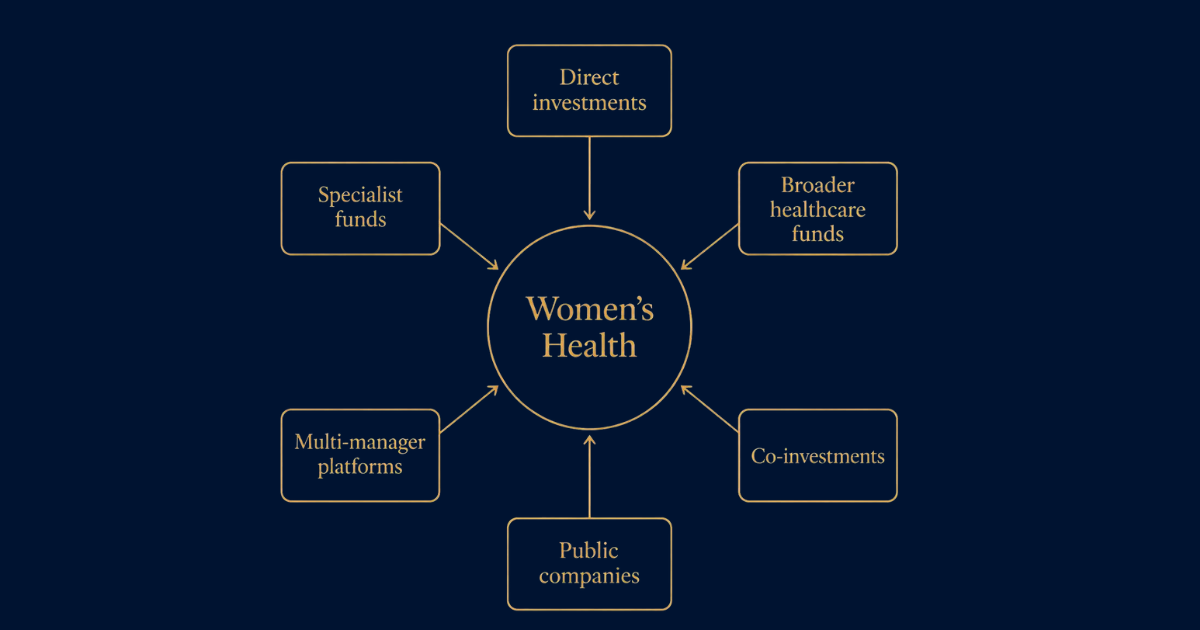
Today, investors can gain exposure to women’s health through:
- Direct investments in private companies
- Specialist women’s-health venture funds
- Broader healthcare and life-sciences funds with meaningful women’s-health exposure
- Diversified investment platforms or fund-of-funds structures
- Co-investments and, where available, secondary transactions
- Selected public companies with relevant products, pipelines or business divisions
Each route offers a different combination of access, diversification, control, liquidity and risk. For most family offices and institutional investors, the central challenge is not in finding individual companies. It is in constructing exposure across a fragmented market without concentrating capital in a handful of early-stage businesses or relying on thematic claims that have not been supported by specialist investment capability.
Why women’s health is not a single investment category
The term “women’s health” covers conditions that affect women:
- Uniquely, such as endometriosis and menopause
- Differently, such as cardiovascular disease
- Disproportionately, such as autoimmune disease and Alzheimer’s disease
Women’s health also extends across various healthcare subsectors such as pharmaceuticals, biotechnology, diagnostics, medical devices, digital health, care delivery, consumer health and Healthcare AI.
With such a wide span of coverage, the risk and return characteristics of one women’s health investment can differ materially from that of another women’s health investment. For example, the risk and return characteristics of an early-stage diagnostic company are fundamentally different from those of a commercial-stage medical-device business.
A reproductive-health platform may have a different go-to-market, reimbursement and execution risks from an oncology biotechnology company. Regulatory pathways, clinical-evidence requirements, capital intensity, time to commercialisation and dependence on follow-on funding can also vary substantially from one investment to the other.
Hence, once an investor has decided to allocate capital to women’s health, the allocator’s task is therefore not simply to select the most compelling opportunities. It is to determine which underlying exposures are appropriate for the portfolio and how they should be combined to achieve the desired balance of risk, return, liquidity and diversification.
Why investors are paying attention now
The investment case begins with a significant mismatch between healthcare need and capital allocation.
The World Economic Forum’s 2026 Women’s Health Investment Outlook, produced with Boston Consulting Group, found that women’s health receives only 6% of private healthcare investment.
Of that limited capital, approximately 90% is concentrated in women’s cancers, reproductive health and maternal health. This concentration leaves high-burden conditions affecting women uniquely, differently or disproportionately comparatively undercapitalised. Endometriosis, PMOS and menstrual health, for example, collectively receive less than 2% of women’s-health investment, according to the report. This does not mean that every underfunded condition represents an attractive investment.
But underinvestment does not, by itself, establish an attractive investment opportunity. It may reflect scientific complexity, uncertain reimbursement, weak business models, limited commercial readiness or a shortage of credible management teams.
Capital scarcity becomes investable only where substantial clinical need converges with scientific progress, enabling technology, viable economics and a credible route to commercialisation. What is changing now is the strength of that convergence.
Advances in diagnostics, data and AI are making previously overlooked conditions and patient populations easier to identify, study and serve while employers, insurers and healthcare systems are increasingly recognising the financial costs of delayed diagnoses, inadequate treatment and poor health outcomes for women.
The result of this convergence can already be seen in the flow of capital into women’s health. Between 2020 and 2025, nearly $60 billion flowed into core women’s health sectors across venture capital, private equity, and corporate investment, and over the past 25 years, exits in the sector, including acquisitions and IPOs, have exceeded $100 billion.
How to invest in women’s health: six principal routes
There are several routes to investing in women’s health. Below are six ways, each with their pros and cons.
1. Direct investment in private companies
A family office can invest directly in women’s-health companies through venture, growth-equity or private-equity transactions.
Direct investment offers the greatest control over company selection. It may also provide governance rights, access to management and the ability to build conviction around a particular condition or technology. However, it also requires specialist investment capability and can result in significant company-specific concentration.
This is particularly important in venture capital, where returns tend to follow a power-law distribution: a small number of exceptional outcomes must compensate for the high failure rate among early-stage companies. Building sufficiently diversified direct exposure may therefore require more capital, expertise and follow-on capacity than many investors wish to commit. Investors must therefore evaluate:
- The strength of the clinical or scientific evidence
- Regulatory pathways
- Reimbursement and procurement
- Product-market fit
- Intellectual property
- Data quality and defensibility
- Management capability
- Capital requirements
- Follow-on financing risk
- Valuation and potential exit routes
A direct portfolio also requires sufficient breadth. Investing in one or two companies may provide exposure to individual company risk rather than meaningful exposure to women’s-health innovation. Direct investing is therefore most appropriate for investors with internal healthcare expertise, the capacity to conduct specialist due diligence and enough capital to construct and support a diversified portfolio over multiple financing rounds.
2. Specialist women’s-health funds
Specialist venture funds provide exposure to a portfolio of companies selected and supported by managers with dedicated knowledge of women’s health. Compared with direct investing, this approach transfers responsibility for sourcing, due diligence, portfolio construction and ongoing company oversight to an experienced manager. A credible specialist manager may offer:
- Proprietary sourcing networks
- Knowledge of relevant conditions and technologies
- Relationships with clinicians, researchers and industry partners
- Experience assessing regulatory and reimbursement pathways
- Portfolio-company support
- Access to follow-on rounds and potential acquirers
For investors without an internal healthcare-investment team, a specialist fund can therefore provide a more efficient and diversified route than constructing and managing a direct portfolio.
The principal trade-off is manager concentration. The investor delegates investment selection, portfolio construction and much of the underlying judgement to a single team. Performance consequently depends not only on the opportunity in women’s health, but on that manager’s sourcing access, investment discipline, decision-making and ability to support companies through multiple stages of development.
Innovation in women’s health is global and spans biotechnology, diagnostics, medical devices, care delivery, digital health and Healthcare AI. A specialist manager may have strong expertise in some areas or geographies while offering limited access to others. Allocating through only one fund may therefore create hidden concentrations and leave important parts of the opportunity set unrepresented.
Relevant questions include:
- How does the manager define women’s health?
- What proportion of the portfolio will provide genuine exposure?
- Does the team possess both investment and healthcare expertise?
- How does it assess clinical evidence and commercial readiness?
- Is the strategy sufficiently diversified by condition, business model and stage?
- Does the fund have enough reserves for follow-on investments?
- How credible is its access to high-quality opportunities?
- Are fund size and portfolio construction consistent with the proposed strategy?
3. Broader healthcare and life-sciences funds
Women’s-health exposure can also be obtained through broader healthcare, biotechnology, medical-technology or life-sciences funds. These managers may offer deeper domain expertise, more established investment processes and greater diversification than a narrowly focused emerging fund. They may also have better access to later-stage companies and established healthcare networks.
4. Diversified platforms and fund-of-funds structures
5. Co-investments
Co-investments allow investors to invest directly alongside a fund manager or a fund-of-fund manager in a particular company. They can provide more concentrated exposure, greater transparency and potentially lower blended fees.
They may also allow an investor to increase exposure to companies that strongly fit its investment thesis. But co-investments should complement a diversified allocation, not replace one. The investor must still assess company-specific risk, valuation, financing requirements and portfolio concentration. Access is also dependent on manager relationships and the quality of the underlying fund pipeline.
6. Public-market exposure
Public-market investors can obtain selected exposure through pharmaceutical, biotechnology, diagnostics, medical-device and healthcare-services companies with relevant products or development pipelines.
This route offers liquidity, price transparency and established financial reporting. The principal limitations are availability and precision. There are relatively few listed pure-play women’s-health companies, while relevant products may represent only a small proportion of a diversified healthcare company’s revenue, valuation or research pipeline. An investor may therefore gain substantial exposure to the broader business while receiving only limited exposure to women’s health.
How institutional investors should evaluate the opportunity
A credible allocation begins with five decisions.
1. Define the intended exposure
The investor should specify what it is trying to access. Is the objective exposure to unmet clinical need, specialist healthcare innovation, early-stage venture, established healthcare businesses or the intersection between women’s health and Healthcare AI? Without a clear definition, “women’s health” can become so broad that the allocation loses meaning.
2. Select the appropriate vehicle
The choice between direct investments, specialist funds, broader healthcare managers and a diversified platform should reflect the investor’s resources and governance capacity. An investor without internal healthcare expertise should be cautious about constructing a concentrated direct portfolio simply because direct ownership appears more transparent.
3. Size the allocation within the total portfolio
Women’s-health investments should be considered within the investor’s existing private-market exposure, liquidity requirements and risk budget. The allocation may contain venture, growth, biotechnology, medical-device and digital-health risks. Its size should reflect the underlying exposures—not the social importance of the theme.
4. Diversify deliberately
Diversification should be assessed across:
- Managers
- Vintage years
- Company stages
- Conditions
- Technologies
- Business models
- Geographies
- Regulatory and reimbursement pathways
A portfolio of five fertility applications is not necessarily diversified merely because it contains five companies.
5. Establish evidence and reporting standards
Investors should require financial reporting alongside relevant measures of clinical, commercial and portfolio progress. Depending on the strategy, useful indicators may include:
- Clinical and regulatory milestones
- Revenue growth and customer retention
- Reimbursement coverage
- Enterprise or health-system contracts
- Patient adoption
- Follow-on financing
- Valuation development
- Exit activity
- Portfolio concentration
- Capital reserves and pacing
Impact claims should not substitute for investment reporting. Equally, conventional financial reporting may fail to capture the operational milestones that determine value creation in healthcare.
The risks investors should not ignore
Women’s health is not protected from the risks affecting healthcare and private markets more broadly. These include:
- Scientific and clinical failure
- Regulatory delays
- Reimbursement uncertainty
- Long commercialisation timelines
- High capital requirements
- Weak evidence or overstated addressable markets
- Customer-acquisition challenges
- Data privacy and cybersecurity
- Dependence on follow-on capital
- Illiquidity
- Valuation risk
- Limited exit routes
Healthcare demand may be structurally supported, but company valuations and investment returns remain sensitive to financing conditions and execution. The correct conclusion is not that women’s health is automatically defensive or inherently high-return. It is that parts of the market combine substantial unmet need with improving science, technology and commercial models and therefore merit disciplined specialist analysis.
What should family offices and institutional investors do first?
The first step is in defining the mandate. Investors should establish:
- The role of the allocation within the total portfolio
- The acceptable level of illiquidity and venture risk
- Whether sufficient internal healthcare expertise exists
- The desired balance between direct and manager-led exposure
- The minimum diversification required
- The governance and reporting standards the investment must meet
Only then should manager and company selection begin. The market is still developing, and the available investment vehicles remain uneven. That makes manager access, due diligence and portfolio construction particularly important.
The investment opportunity is real. Capturing it requires infrastructure.
Women’s health presents substantial unmet need, identifiable commercial markets and growing investment activity. But need alone does not generate returns, and underinvestment alone does not make an opportunity investable.
Capital must still find the right companies, through the right managers, at appropriate valuations and within portfolios designed to withstand the risks of healthcare innovation. This is why the next phase of women’s-health investment will not be defined only by the amount of capital entering the market. It will be defined by the quality of the investment infrastructure built around it.
For family offices and institutional investors, the central question is therefore not simply whether to invest in women’s health. It is how to do so with the specialist judgement, diversification and discipline the opportunity requires.
References
Why Investment in the Women’s Health Industry is About to Explode | Fast Company